Ethical Wildlife Tourism:
The Photo and What It Costs
By Steven Keen
MSc Responsible Tourism Management (in progress), GSTC- and ICRT-certified
15 min read Updated on Sources verified on
Every unethical wildlife attraction sells the same product: a photo. The tiger selfie, the elephant ride, the orca show—packaged as a memory, priced as a souvenir. This page shows what the photo costs the animal in it—and how to see wild animals in the only way that leaves them wild.
Key Takeaways
- The photo is the product and the suffering is the manufacturing process: if you can ride it, hug it, or pose with it, the harm already happened.
- Your eyes are not a reliable instrument—only 7.8% of tourist reviews of harmful wildlife attractions raise any welfare concern at all. The Five Freedoms are the instrument.
- The word “sanctuary” means nothing; four behaviors mean everything: no breeding, no contact, documented origins, independent accreditation.
- Ethical wildlife tourism exists—wild, unforced, at a distance, on the animal’s terms.
Harm Sold as a Highlight
The largest study of wildlife tourist attractions—University of Oxford researchers, working through 24 attraction types worldwide—found that 18 of them, holding between 230,000 and 550,000 wild animals, harm the welfare of the animals inside them. The same study found something stranger: of the tourists who visited those harmful attractions and wrote reviews, only 7.8% raised any welfare or conservation concern at all.1 The other 92% had a wonderful time.
That gap is the entire problem, and it is not a gap in kindness. The visitors were not cruel; they were positioned. A wildlife attraction is a theater whose whole design exists to keep the manufacturing process out of the frame: the training happened before you arrived, the chains are backstage, and the animal in front of you has been selected precisely because it no longer resists. The evidence of harm is not hidden from you by distance. It is hidden by the photo itself.
You cannot see cruelty from the customer’s side of a wildlife attraction. That is what the attraction is for.
So this page does what the venue never will: it turns the three best-selling photos in wildlife tourism around.
The Photo and What’s Behind It
Three images, presented exactly as the brochures present them. Each is real, popular, and rated five stars. Turn them over:
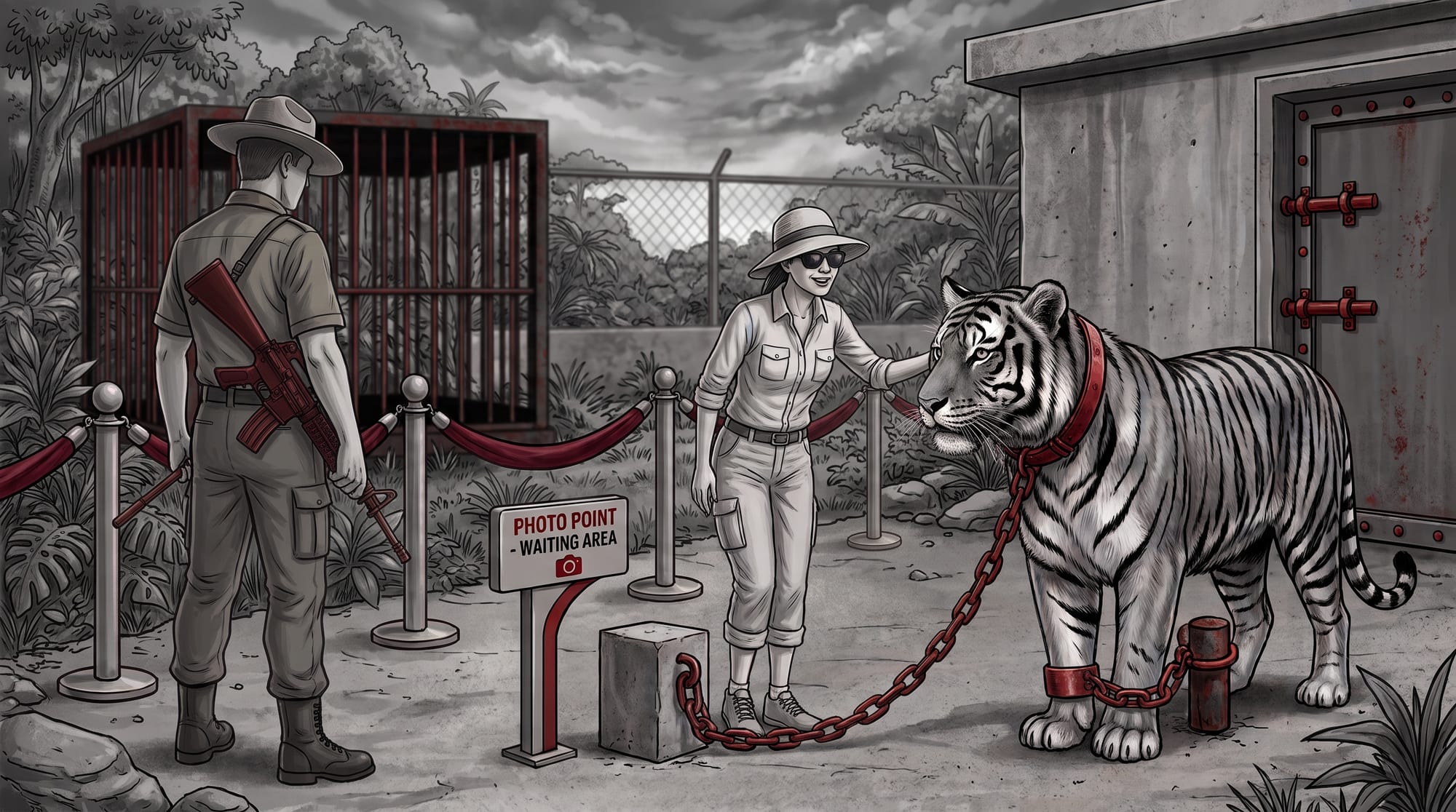
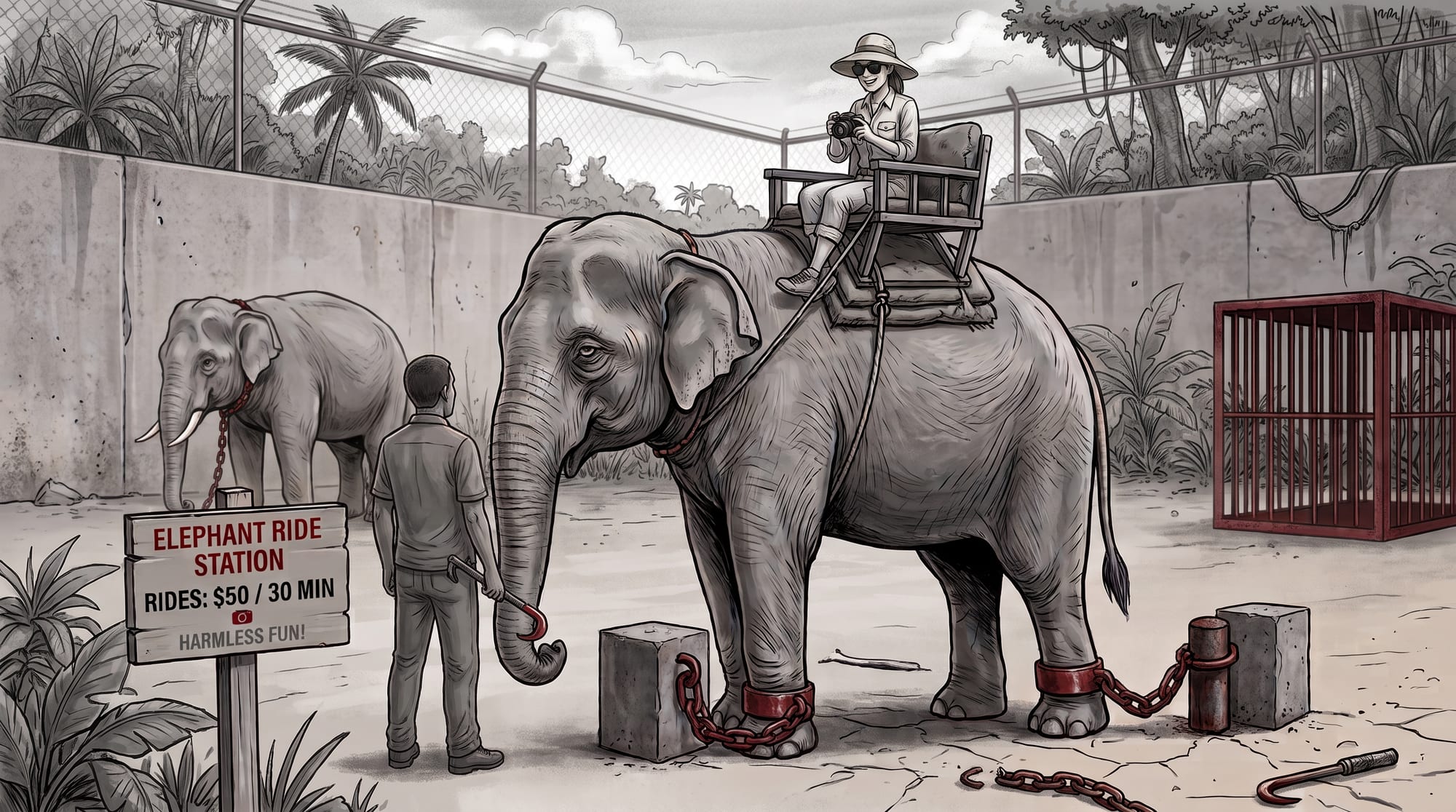
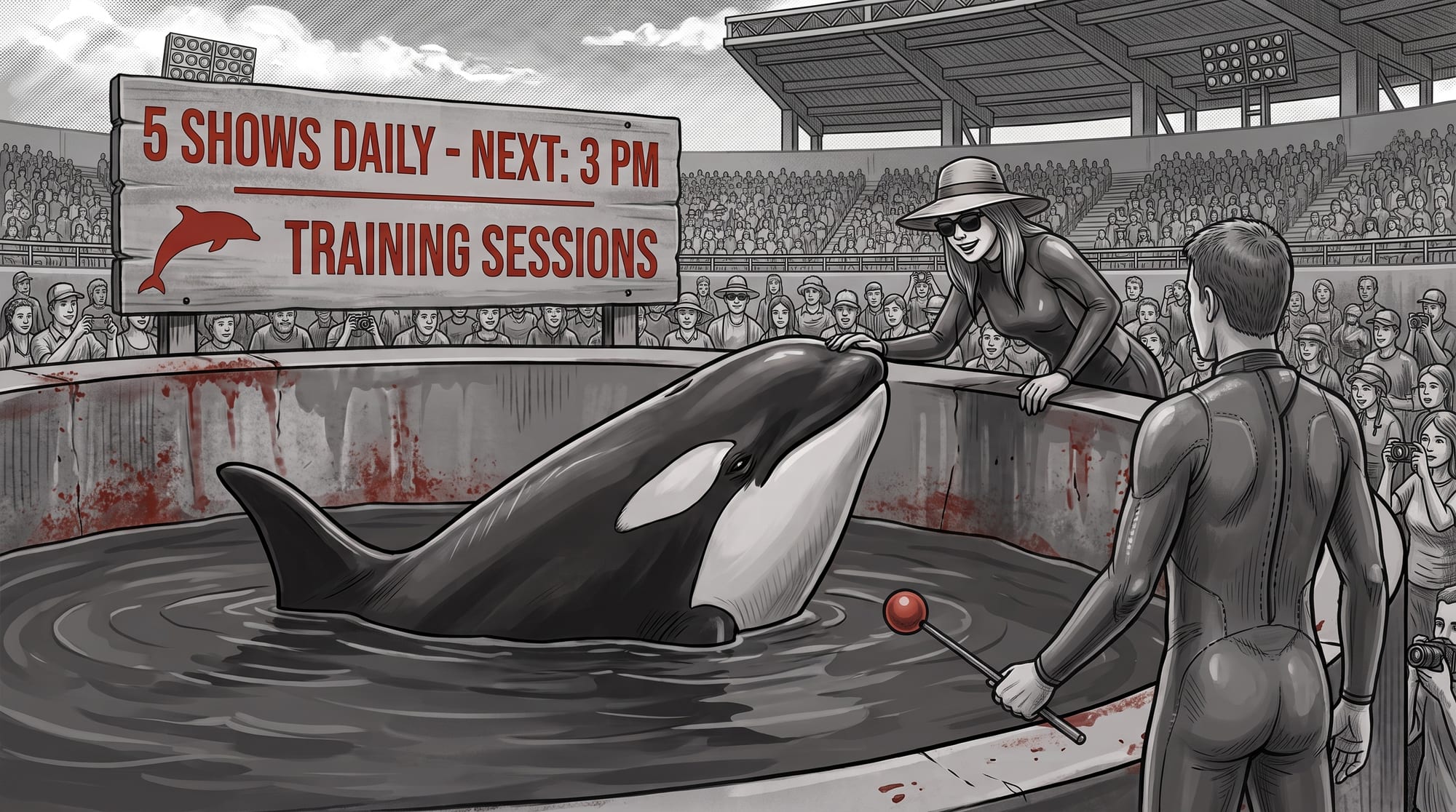
The photo is the product. The suffering is the manufacturing process.
In the largest study of wildlife tourist attractions, only 7.8% of visitors raised any welfare concern at all.
Photo 1 of 3 · The Tiger Selfie
A tiger calm enough to lie beside a stranger is not tame. It is managed.
Cubs are removed from their mothers within days of birth so tourists can hold them; adults are kept handleable by routine, chaining, and exhaustion. Where the animals go when they outgrow the photo line was answered at the industry’s most famous venue: when Thai authorities raided the Tiger Temple in 2016, they removed 137 living tigers—and found 40 dead cubs in a freezer, 20 more preserved in jars, and some 1,500 tiger-skin amulets. The photo prop and the trafficking inventory were the same animal.
In someone’s feed, this photo is a confession that nobody has read yet.
Book instead: Tigers in the wild, on a counted, distance-keeping safari—or not at all. A tiger you can touch is a tiger being harmed.
Photo 2 of 3 · The Elephant Ride
No elephant carries a stranger voluntarily.
To accept a saddle, a young elephant is put through what trainers themselves call the crush—phajaan: separation, restraint, and pain until its resistance breaks. That is the entry ticket to the industry World Animal Protection documented in 2017: of 2,923 elephants surveyed at tourism venues across Thailand, Sri Lanka, Nepal, India, Laos, and Cambodia, 77% were held in severely inadequate conditions—chained when not working, on concrete, in noise, with poor diets and little care.
The ride lasts thirty minutes. The training lasted a childhood.
Book instead: Observation-only sanctuaries and wild encounters at a distance—no riding, no bathing, no shows, anywhere.
Photo 3 of 3 · The Orca Show
The “smile” is the same shape when she is suffering.
An orca is the largest of the dolphins, and a dolphin’s smile is fixed anatomy—it cannot change, whatever the animal feels. World Animal Protection’s 2019 industry survey found more than 3,000 dolphins held for entertainment in 336 venues across 54 countries, two-thirds of them in barren concrete tanks averaging 444 square meters—for animals that range tens of kilometers a day at sea. The show runs on hunger: tricks are traded for food, on a schedule, in front of a paying grandstand.
She has performed the same trick for the same photo since the day she stopped having anywhere to go.
Book instead: Wild cetaceans from shore or a licensed, distance-keeping boat—on their terms, in their sea.
Embed this graphic
Free to embed. The embed keeps a visible credit linking back to this page.
None of these is an outlier or an urban legend. The Tiger Temple raid is court record and photographic fact: 137 living tigers, 40 dead cubs in a freezer, 20 more in jars, some 1,500 skin amulets.2 The elephant figures come from the industry’s largest field survey—2,923 animals, 77% in severely inadequate conditions3—and the dolphin numbers from a venue-by-venue census: more than 3,000 animals, two-thirds of them in tanks averaging 444 square meters, in an industry worth up to $5.5 billion a year.4 The attraction changes; the arithmetic does not. The photo is the product, and the suffering is the manufacturing process.
After this page, a tiger selfie in someone’s feed reads as a confession, not a memory—theirs, and once, perhaps, yours. That change of sight is permanent, and it is the point.
The Five Freedoms Test
Since your eyes cannot be trusted inside an attraction, you need an instrument. The baseline of animal welfare has been written down since 1979, when the UK’s Farm Animal Welfare Council set out the Five Freedoms:5
- 1.Freedom from hunger and thirst—yet show animals perform because food is withheld until they do.
- 2.Freedom from discomfort—yet ride elephants stand chained on concrete between shifts.
- 3.Freedom from pain, injury, and disease—yet the crush, the bullhook, and the saddle are the industry’s tools of trade.
- 4.Freedom to express normal behavior—yet a tank averaging 444 square meters replaces an ocean, and a photo bench replaces a hunt.
- 5.Freedom from fear and distress—yet docility for the camera is exactly what fear, learned early, looks like.
Modern welfare science has extended the freedoms into the Five Domains model, which also weighs the animal’s mental state and its interactions with humans6—a higher bar still. But no captive-wildlife entertainment survives even the 1979 version. Run any ride, show, or selfie through the five lines above: the attraction does not fail one freedom by accident; it fails most of them by design, because the product requires the failure. An elephant with freedom to express normal behavior does not carry tourists. A tiger without fear does not lie still.
The Five Freedoms are not a scorecard where four out of five passes. They are five ways of asking one question: is this animal still an animal, or has it become equipment?
Sanctuary or Scam? The Four Tests
The industry heard the criticism—and rebranded. The same cub-petting operations and elephant camps now trade as “sanctuaries,” “rescue centers,” and “ethical experiences,” because the words cost nothing and screen out no one. The word is not evidence. Behavior is. Four tests, drawn from the standards of the Global Federation of Animal Sanctuaries, separate the real thing from the sign:
1. Does it breed its animals?
True sanctuaries do not intentionally breed—a rescue mission has no use for new captives. Breeding means the “sanctuary” needs a supply of babies: for petting, photos, and ticket sales.
2. Can you touch, hold, or pose with the animals?
Genuine sanctuaries do not allow public contact—it stresses the animals and requires exactly the “manageability” that cruelty produces. If you can hug it, it is inventory.
3. Are the animals’ origins documented and public?
A real rescue can tell you where every animal came from—the confiscation, the closed circus, the injury. Vagueness about origins usually means the origin is the problem.
4. Is it independently accredited (GFAS or equivalent)?
Accreditation by the Global Federation of Animal Sanctuaries means an outside auditor verified the standards. “Self-certified” means the sign certified the sign.
The word “sanctuary” is not evidence. The four behaviors are. Answer the questions above.
Keep going—every test matters.
All four behaviors check out. This is what a true sanctuary looks like.
That is a scam signal. However the sign reads—walk away. Your ticket funds the behavior.
Embed this graphic
Free to embed. The embed keeps a visible credit linking back to this page.
Note what the tests have in common: every one of them is checkable from your sofa. Breeding shows up in the venue’s own baby-animal marketing; contact policies are printed on the ticket page; origins are either published or conspicuously absent; and GFAS accreditation can be verified in its public directory.7 A venue that fails the tests has not failed a technicality—it has told you its business model.
What Ethical Wildlife Tourism Looks Like
The answer to a corrupted industry is not to stop looking at animals. Wildlife watched ethically is one of the strongest economic arguments conservation has: it makes a living animal, in living habitat, worth more year after year than its parts, its pelt, or its performance. The conditions are strict but simple—wild, unforced, at a distance, on the animal’s terms:
- The animal controls the encounter. It can leave at any time, and sometimes it does—the honest venue does not promise sightings, let alone photos.
- Distance is kept, always. For marine life, NOAA’s viewing guidelines set the pattern any operator worldwide can be measured against: minimum distances, time limits, and never feeding, chasing, or altering behavior.8
- Groups are small and guides are licensed—and both facts are verifiable before you book, in writing, like everything else on this site.
- The money reaches the habitat. Fees that fund rangers, reserves, and local communities make the animal’s protection someone’s livelihood—the flywheel that poaching and captivity can never spin.
The reliable sign that you have found the real thing is, paradoxically, inconvenience: the early start, the long quiet wait, the sighting that may not come. Everything in wildlife tourism that is guaranteed, punctual, and photogenic was made that way—and now you know how.
THE CODE · FREE · NO EMAIL
Don’t Buy Your Own Good Intentions
An ethical trip is never guessed—it is checked into existence. Eleven evidence-based pages that turn good intentions into questions you can book on. Free and yours to keep.
Get the free codeThe Honest Gray Zones
An honest page admits where the lines blur:
- Zoos and aquariums span the full moral range—from research-active, conservation-accredited institutions to animal shows with better landscaping—and deserve the same behavioral tests as sanctuaries rather than a blanket verdict; two bright lines hold regardless: venues selling direct contact, and cetacean shows, which no tank can redeem.4
- Working animals—the mule on a mountain path, the horse cart licensed and inspected—are a domesticated-labor question, governed by load limits, rest, heat, and care; real welfare standards exist, and the difference between a working animal and an exploited one is whether anyone enforces them.
- Rehabilitation centers that genuinely release animals may need temporary human contact that a sanctuary would never allow—the test is whether release is documented or merely promised.
Gray zones reward the same discipline as everything else on this page: ask for the behavior, not the branding. The venues that resent the questions have answered them.
What You Can Do
The captive-wildlife industry runs on one input: the visitor who did not know. You now know. The working rules:
- Choose observation over interaction, every time. Riding, holding, bathing, feeding, posing—if a wild animal is close enough to touch, the harm already happened.
- Run the four tests on anything called a sanctuary—no breeding, no contact, documented origins, independent accreditation. One failure is a verdict.
- Keep the wild rules wild: distance, small groups, licensed guides, nothing fed or baited—and book operators who put those limits in writing.
- Refuse the photo props—and say why. Every declined selfie, every review that names the harm, moves the 7.8% that the researchers found toward a number the industry cannot survive.
- Leave the wildlife souvenirs on the shelf. Corals, shells, tortoiseshell, “medicinal” animal products, reptile leather—trade in some 40,000 protected species is regulated under CITES across more than 180 countries,9 and the souvenir that cleared a market stall may not clear your customs. The animal paid either way.
Then run any remaining doubt through the three questions. The companion deep dives continue with the people behind the trip and living culture on Crete.
Frequently Asked Questions
Is it ethical to ride elephants?
Are tiger selfies really that harmful?
How can I tell a real sanctuary from a fake one?
Is it okay to visit zoos and aquariums?
What does ethical wildlife watching look like?
Case Study: CRETAN®
The standard is not “no animals.” It is “on their terms.” CRETAN®—disclosed here as our case study—runs its tours through the wild landscapes of Crete on exactly that footing:
- Wildlife is observed where it lives—vultures over the gorges, wild goats on the ridgelines—never fed, baited, handled, or staged.
- Small groups on shepherd paths, scaled to what the mountains can absorb—the encounter ends whenever the animal decides it does.
- No animal entertainment anywhere in the model—the landscape itself is the show, and it performs on its own schedule.
Steven spent a decade making documentaries in the places tourism forgets—with his work held in the archives of the UN’s International Labour Organization—before he went to live in one. He is completing an MSc in Responsible Tourism Management and founded CRETAN®, which appears here as a case study among the frameworks.
Read more about this resourceLetters from inside the question
Once a Month, a Letter from Crete
Most travel writing is polished, and written from the outside. This one is unfiltered and written from within: a mountain village on Crete. No noise.
No spam. Ever. Leave anytime. Our Privacy Policy.
Where to Go from Here
What Is Ethical Tourism?
The framework behind the four tests: the definition, the five pillars, and the three questions that govern every encounter.
Ethical Tourism & Human Rights
The same demand logic applied to people: the orphanage paradox, child protection, and fair work behind the welcome.
Ethical Travel Guide for Crete
An island where watching stays wild: kri-kri in the gorges, Natura 2000 habitats, and no cages required.
Explore Our Companion Resources
- regenerativetravel.org After the cage: citizen science with iNaturalist, seagrass snorkel surveys, and field protocols that let wildlife watching feed conservation.
- responsibletourism.com Wild animals met on their own terms—Natura 2000 habitats, the kri-kri and monk seal, and the trail rules that protect them.
- inclusivetourism.com Wild places for every body: all-terrain wheelchairs, the six trail measurements, and how to verify access before you go.
Last updated:
References
- Moorhouse, T. P., Dahlsjö, C. A. L., Baker, S. E., D’Cruze, N. C. & Macdonald, D. W. 2015. The Customer Isn’t Always Right—Conservation and Animal Welfare Implications of the Increasing Demand for Wildlife Tourism. PLOS ONE 10(10)—of 24 wildlife tourist attraction types studied, 18 (holding 230,000–550,000 wild animals) had negative welfare impacts, yet only 7.8% of tourist reviews raised welfare or conservation concerns. PLOS ONE (University of Oxford WildCRU, commissioned by World Animal Protection). https://journals.plos.org/plosone/article?id=10.1371/journal.pone.0138939 (accessed July 9, 2026). ↩
- National Geographic. 2016. Wildlife Watch: the Tiger Temple raid—Thai authorities removed 137 living tigers from the Kanchanaburi temple and found 40 dead cubs in a freezer, 20 more preserved in jars, and some 1,500 tiger-skin amulets. National Geographic. https://www.nationalgeographic.com/animals/article/wildlife-watch-tiger-temple-monks-trafficking-zoo (accessed July 9, 2026). ↩
- World Animal Protection. 2017. Taken for a Ride: The Conditions for Elephants Used in Tourism in Asia—of 2,923 elephants surveyed at venues in Thailand, Sri Lanka, Nepal, India, Laos, and Cambodia, 77% were held in severely inadequate conditions; documents the phajaan (“crush”) training that breaks young elephants for riding. World Animal Protection. https://www.worldanimalprotection.org/globalassets/pdfs/reports/english/taken-for-a-ride.pdf (accessed July 9, 2026). ↩
- World Animal Protection. 2019. Behind the Smile: The Multibillion-Dollar Dolphin Entertainment Industry—at least 3,029 dolphins held in 336 venues across 54 countries; two-thirds in barren tanks averaging 444 m², roughly 200,000 times smaller than a wild home range; an industry generating $1.1–5.5 billion a year. World Animal Protection. https://www.worldanimalprotection.us/siteassets/reports-programmatic/behind-the-smile-report.pdf (accessed July 9, 2026). ↩
- Farm Animal Welfare Council (FAWC). 1979. Press statement of December 5, 1979 establishing the Five Freedoms—freedom from hunger and thirst; from discomfort; from pain, injury, and disease; to express normal behavior; and from fear and distress. FAWC (archived). https://archive.org/details/1979.-five-freedoms.-farm-animal-welfare-council.-brambell-comittee (accessed July 9, 2026). ↩
- Mellor, D. J., Beausoleil, N. J., Littlewood, K. E., et al. 2020. The 2020 Five Domains Model: Including Human–Animal Interactions in Assessments of Animal Welfare. Animals 10(10), 1870—the modern welfare-science extension of the Five Freedoms. Animals (open access via PubMed Central). https://pmc.ncbi.nlm.nih.gov/articles/PMC7602120/ (accessed July 9, 2026). ↩
- Global Federation of Animal Sanctuaries (GFAS). Position statements and standards of excellence—true sanctuaries do not intentionally breed and do not allow direct public contact with wildlife; accreditation verifies the standards independently. GFAS. https://sanctuaryfederation.org/about-gfas/position-statements/ (accessed July 9, 2026). ↩
- NOAA Fisheries. Marine Life Viewing Guidelines—the US federal standard for watching wild marine animals: distance, time limits, and never feeding or chasing. National Oceanic and Atmospheric Administration. https://www.fisheries.noaa.gov/topic/marine-life-viewing-guidelines (accessed July 9, 2026). ↩
- CITES Secretariat. Convention on International Trade in Endangered Species of Wild Fauna and Flora—the treaty under which more than 180 parties regulate trade in some 40,000 protected species, including the corals, shells, and skins sold as souvenirs. CITES. https://cites.org/eng (accessed July 9, 2026). ↩
Further Reading
- Wildlife. Not Entertainers—research and campaigns on wild animals used in tourism
World Animal Protection · World Animal Protection
- Find an accredited sanctuary—the searchable directory of independently verified sanctuaries
Global Federation of Animal Sanctuaries · GFAS
- Research on wildlife tourism, the wildlife trade, and consumer behavior
University of Oxford, Wildlife Conservation Research Unit (WildCRU) · University of Oxford
- Research and policy on cetaceans in captivity and responsible whale watching
Whale and Dolphin Conservation (WDC) · WDC
Our Editorial Standards
This is an independent resource, written and maintained by Steven Keen—a responsible tourism practitioner based on Crete, completing an MSc in Responsible Tourism Management and certified by the GSTC and ICRT. Every statistic is cited to its primary source, every page carries an honest last-updated date, and where a figure cannot be verified, we flag it—rather than guess. Seasonal claims—festivals, opening patterns, on-island services—are re-checked on the island as the seasons turn, and every reference carries the date it was last accessed. We disclose our connection to CRETAN®, which appears here as one documented case study among the frameworks.
Read our full editorial standards